Developer contributions explained
Key points
- Local authorities require developers to make financial contributions as part of the process of granting planning permission.
- Developer contributions fund infrastructure and amenities for local communities such as schools, healthcare facilities, open spaces, Affordable Housing, and transport, worth at least £6 billion a year.
- In 2024/25, 42% of all new build Affordable Homes were delivered by the private sector through Section 106 agreements.
- Home builders are now waiting an average of 17 months for Section 106 agreements to be finalised, adding significant delays to an already complex planning process.
- An estimated £9 billion of contributions is currently held unspent by local authorities, leaving some communities without vital new infrastructure.
What are developer contributions?
Developer contributions are financial payments or in-kind provisions required from developers when local authorities grant planning permission. They help fund infrastructure and services needed to support new development, such as schools, healthcare facilities, open space, and road improvements.
There are two main types of contributions developers make to local authorities when securing planning permission.
- Section 106 agreements, which refer to Section 106 of the Town and Country Planning Act 1990, are legal agreements negotiated between developers and local authorities to help make a development acceptable in planning terms. Section 106 obligations can include both financial and in-kind contributions.
- The Community Infrastructure Levy (CIL) is a charge that local authorities can levy on new development. In areas where a CIL schedule has been introduced, the levy is compulsory. CIL was introduced in 2012, and around 50% of councils currently operate a CIL. In London, a Mayoral CIL applies across all 32 boroughs.
While Section 106 contributions are used to mitigate the impact of a specific development, such as the provision of a new school or road improvements, CIL funds are used more strategically across a wider geographical area, for example, to support new public transport systems.
How are contribution amounts agreed for both Section 106 and CIL?
Section 106 contributions are negotiated between developers and local authorities, with the amount to be paid depending on the size of the development, the viability of the scheme, and the specific needs of the local community, in line with policies set out in the Local Plan.
In contrast, CIL is based on a fixed charging schedule and published levy rates, which can vary by type of site but cannot be negotiated.
How much investment do developer contributions provide to local communities each year?
Under the current arrangements, the Ministry of Housing, Communities and Local Government (MHCLG) estimates that developers make contributions worth around £6 billion per annum in total, delivering significant investment in local communities.
HBF and Lichfields estimates, based on a survey of housebuilders across England and Wales, show that every year the Section 106 system delivers around:
- £600 million towards new and approved schools
- £192 million of investment in open space, community sport and leisure
- £53 million for healthcare facilities
- Over £100 million for public transport and active travel.
The Competition and Markets Authority (CMA) notes that annual developer contribution receipts are equivalent to 46% of total annual local government spending on housing and community development and equal to the total amount spent by local government on infrastructure each year.
What role does Section 106 play in delivering Affordable Housing?
Section 106 agreements are used to deliver new Affordable Homes, and the majority of the value captured through the Section 106 mechanism is now allocated for this purpose. CIL funds cannot be used for Affordable Housing.
In 2024/25, 24,544 new Affordable Homes were delivered through Section 106 agreements. This represents 42% of all new build Affordable Homes, with the remainder delivered by Registered Providers or local authorities, and constitutes 13% of all new build homes of any tenure.

At its peak in 2019/20, 57% of new build Affordable Homes were provided through Section 106. The decline since then does not reflect home builders failing to meet their Section 106 obligations. Instead, it reflects the overall reduction in private sector housing delivery, the timing of the Affordable Homes Programme, and viability pressures arising from new policy costs. Ultimately, an increase in private sector housing delivery would expand opportunities to use Section 106 agreements to deliver more Affordable Housing.
Why are large sums of contributions held unspent?
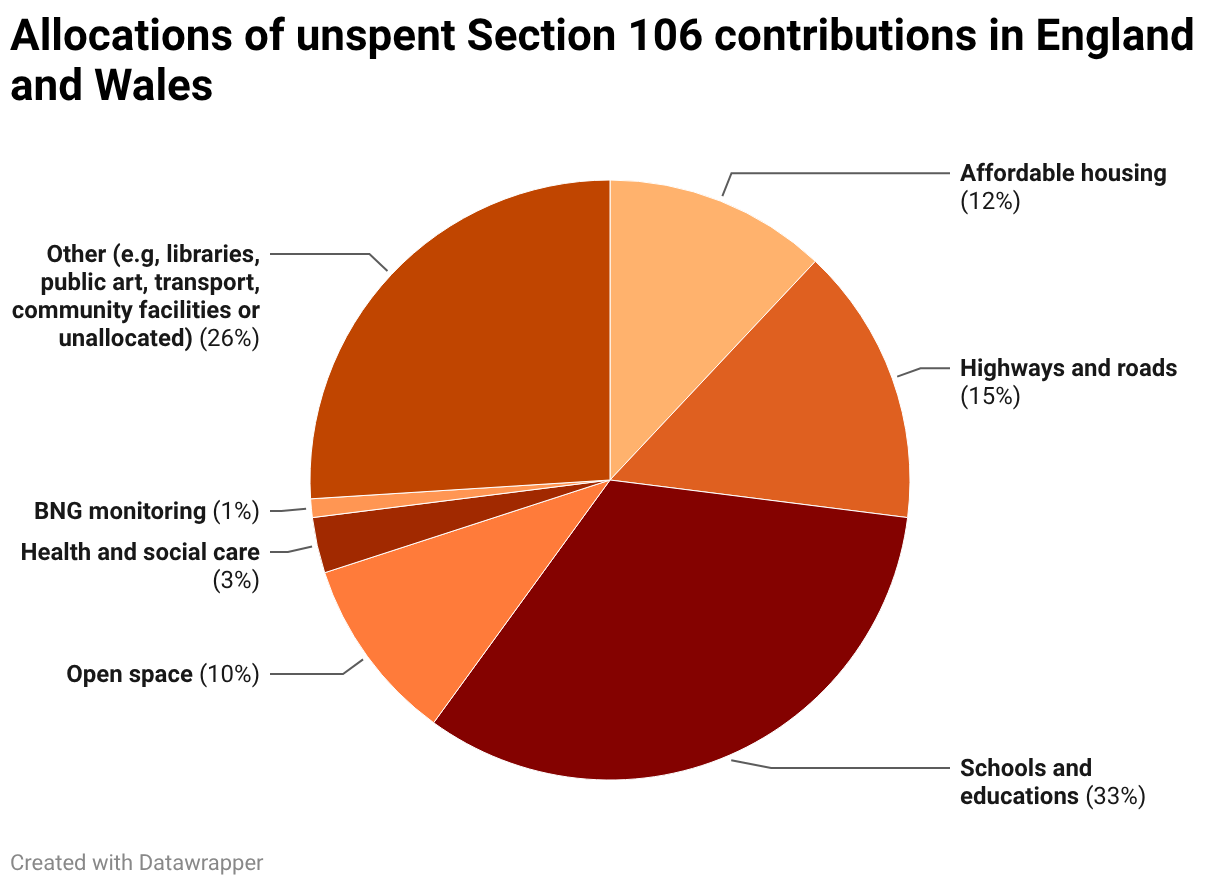
HBF research published in February 2026 shows that around £9 billion of developer contributions are currently held unspent by local authorities – an increase of £800 million (9%) from HBF’s estimate in mid-2024. This includes an estimated £6.6 billion of Section 106 contributions and £2.2 billion of Community Infrastructure Levy contributions.
Of this unspent Section 106 funding, £700 million is earmarked for Affordable Housing and £2 billion for schools, which we estimate could deliver around 8,500 affordable homes and 112,000 new school places.
Where councils do hold disproportionate sums that are well beyond the national average, this may reflect capacity constraints within local authority planning and infrastructure teams, poor monitoring and auditing of funds, or the absence of a coherent local strategy for infrastructure delivery.
The structure of the contributions themselves can also cause delays, as Section 106 agreements are often tied to specific triggers or projects, meaning funds cannot always be spent immediately or flexibly.
Finally, there is often poor coordination between local authorities and public service providers. For instance, 17 out of 43 NHS Integrated Care Boards (ICBs) hold unspent developer contributions, transferred to them by councils to build new healthcare facilities such as GP surgeries - an average of £7.5 million for each ICB. 6 ICBs also report having requests to councils for developer contributions refused in the past three years, in some cases because councils have simply not responded to requests. This suggests a lack of coordination between councils and ICBs on how funds will be used prior to developers paying the funds.
How do developer contributions interact with viability?
Viability (whether the total revenue generated from selling the finished homes exceeds the total cost of developing them) has become increasingly challenging on many sites in recent years due to a range of new policy costs, taxes, and regulations affecting the industry. HBF estimates that these new costs have the potential to add £76,000 to the cost of building a home compared to five years ago. This is significantly more than the average house price inflation in the same period. Section 106 contributions themselves have also increased by almost £1,000 per home in the past five years due to inflation levels, representing an additional cost to consider when assessing the viability of home building.
These new policy costs, including Biodiversity Net Gain (BNG), nutrient neutrality, and the forthcoming Building Safety Levy, reduce the amount of value that can be captured for Section 106 funding and Affordable Housing. In effect, they represent a significant transfer of resources from local government to national government, leaving fewer funds available for local communities.
If land values and/or Section 106 contributions are not adjusted to account for these additional policy costs, some sites may become unviable and fail to come forward for development. In such cases, negotiation or re-negotiation of local Affordable Housing thresholds and Section 106 contributions may be necessary.
Where schemes would otherwise be unviable, multiple factors influence the outcome, including the attractiveness of delivering housing in that locality and the local planning authority’s wider housing strategy. If a policy threshold for Affordable Housing cannot be fully met, it is still beneficial for all stakeholders if a Section 106 negotiation results in housing delivery that would not otherwise occur, typically including a proportion of Affordable Housing even if below the full policy target.
What is the industry calling for to improve the system?
The current framework for developer contributions is broadly supported by the home building industry and offers significant benefits for local authorities, communities and industry, including high levels of investment, flexibility, and bespoke infrastructure delivery for local needs.
However, improvements are needed to ensure the system operates efficiently and delivers for local communities. The industry has therefore called for:
- Adequate resources for local planning authorities so they can negotiate Section 106 agreements and spend developer contributions without unnecessary delays.
- Improved transparency and accountability regarding unspent funds so that councils spend developer contributions in full and on time. This could include requiring Infrastructure Funding Statements (IFS) to outline the reasons why developer contributions have not yet been spent and a breakdown of how long money has been held for.
- Ensure unspent Section 106 contributions can continue to be used for infrastructure serving the development where infrastructure needs have changed, rather than automatically reverting to developers.
- A moratorium on new policy requirements that could further impact viability, particularly the Building Safety Levy and Landfill Tax rises, which would further reduce available funding for Affordable Housing and infrastructure.
Where can I find more information?
- The Economic Footprint of Home Building report.
- HBF's unspent developer contributions research.
- Improving local areas through developer funding: HBF submission to Public Accounts Committee inquiry.
- HBF's 'The Viability Crunch' report.
- HBF's Housing Calculator.
If you have any questions about developer contributions, contact our Policy team at policy@hbf.co.uk.
Find out more about our policy work
View the latest HBF correspondence with Government and recent activity